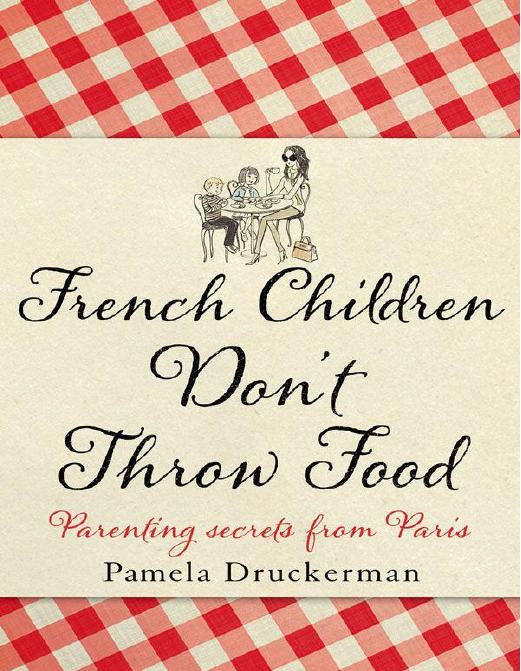
French Children Don't Throw Food by Druckerman Pamela
Author:Druckerman, Pamela [Druckerman, Pamela]
Language: eng
Format: epub, pdf
ISBN: 9781448127153
Publisher: Random House UK
Published: 2012-01-19T00:00:00+00:00
9
Caca Boudin
WHEN BEAN IS about three, she starts using an expression I’ve never heard before. At first I think it’s caca buddha, which sounds like it could be vaguely offensive to my Buddhist friends (as in English, caca is a French kid’s term for poo). But after a while I realize she’s saying caca boudin (pronounced boo-dah). Boudin means sausage. My daughter is going around shouting – if you’ll pardon my French – ‘poo sausage’ all the time.
Like all good curse words, caca boudin is versatile. Bean shouts it gleefully when she’s running through the house with her friends. She also uses it to mean ‘whatever’, ‘leave me alone’ and ‘none of your business’. It’s an all-purpose retort.
Me: ‘What did you do at school today?’
Bean: ‘Caca boudin.’ (snortle)
Me: ‘Would you like some more broccoli?’
Bean: ‘Caca boudin!’ (hysterical laughter)
Simon and I aren’t sure what to make of caca boudin. Is it rude or cute? Should we be angry or amused? We don’t understand the social context. To be safe, we tell her to stop saying it. She compromises by continuing to say it, but then adding, ‘We don’t say caca boudin. It’s a bad word.’
Bean’s budding French does have perks. When we go back to America for Christmas, my mother’s friends keep asking her to pronounce the name of her hairdresser, Jean-Pierre, with her Parisian accent. (Jean-Pierre has given Bean a pixie haircut that they coo is oh-so-French too.) Bean is happy to sing, on demand, some of the dozens of French songs she’s learned in school. I’m amazed the first time she opens a present and says, spontaneously, oh là là!
But it’s becoming clear that being bilingual is more than just a party trick, or a neutral skill. As Bean’s French improves, she’s starting to bring home not just unfamiliar expressions, but also new ideas and rules. Her new language is making her into not just a French speaker but a French person. And I’m not sure that I’m comfortable with that. I’m not even sure what a ‘French person’ is.
The main way that France enters our house is through school. Bean has started école maternelle, France’s free state nursery school. It’s all day, four days a week, and not on Wednesdays. Maternelle isn’t compulsory, and kids can go part-time. But pretty much every three-year-old in France goes to maternelle full-time, and has a similar experience there. It’s France’s way of turning toddlers into French people.
The maternelle has lofty goals. It is, in effect, a national project to turn the nation’s solipsistic three-year-olds into civilized, empathetic people. A booklet for parents from the education ministry explains that in maternelle kids ‘discover the richness and the constraints of the group that they’re part of. They feel the pleasure of being welcomed and recognized, and they progressively participate in welcoming their fellow students.’
Charlotte, who’s been a teacher at maternelle for thirty years (and still charmingly has the kids call her maîtresse – teacher or, literally, ‘mistress’), tells me that in the first year the kids are very egotistical.
Download
French Children Don't Throw Food by Druckerman Pamela.pdf
This site does not store any files on its server. We only index and link to content provided by other sites. Please contact the content providers to delete copyright contents if any and email us, we'll remove relevant links or contents immediately.
Still Foolin’ ’Em by Billy Crystal(36359)
We're Going to Need More Wine by Gabrielle Union(19046)
Plagued by Fire by Paul Hendrickson(17413)
Pimp by Iceberg Slim(14508)
Molly's Game by Molly Bloom(14145)
Becoming by Michelle Obama(10027)
When Breath Becomes Air by Paul Kalanithi(8447)
Educated by Tara Westover(8054)
The Girl Without a Voice by Casey Watson(7889)
The Incest Diary by Anonymous(7699)
Note to Self by Connor Franta(7671)
How to Be a Bawse: A Guide to Conquering Life by Lilly Singh(7486)
The Space Between by Michelle L. Teichman(6941)
What Does This Button Do? by Bruce Dickinson(6207)
Imperfect by Sanjay Manjrekar(5878)
Permanent Record by Edward Snowden(5847)
A Year in the Merde by Stephen Clarke(5431)
Shoe Dog by Phil Knight(5269)
Promise Me, Dad by Joe Biden(5154)
